Power Systems
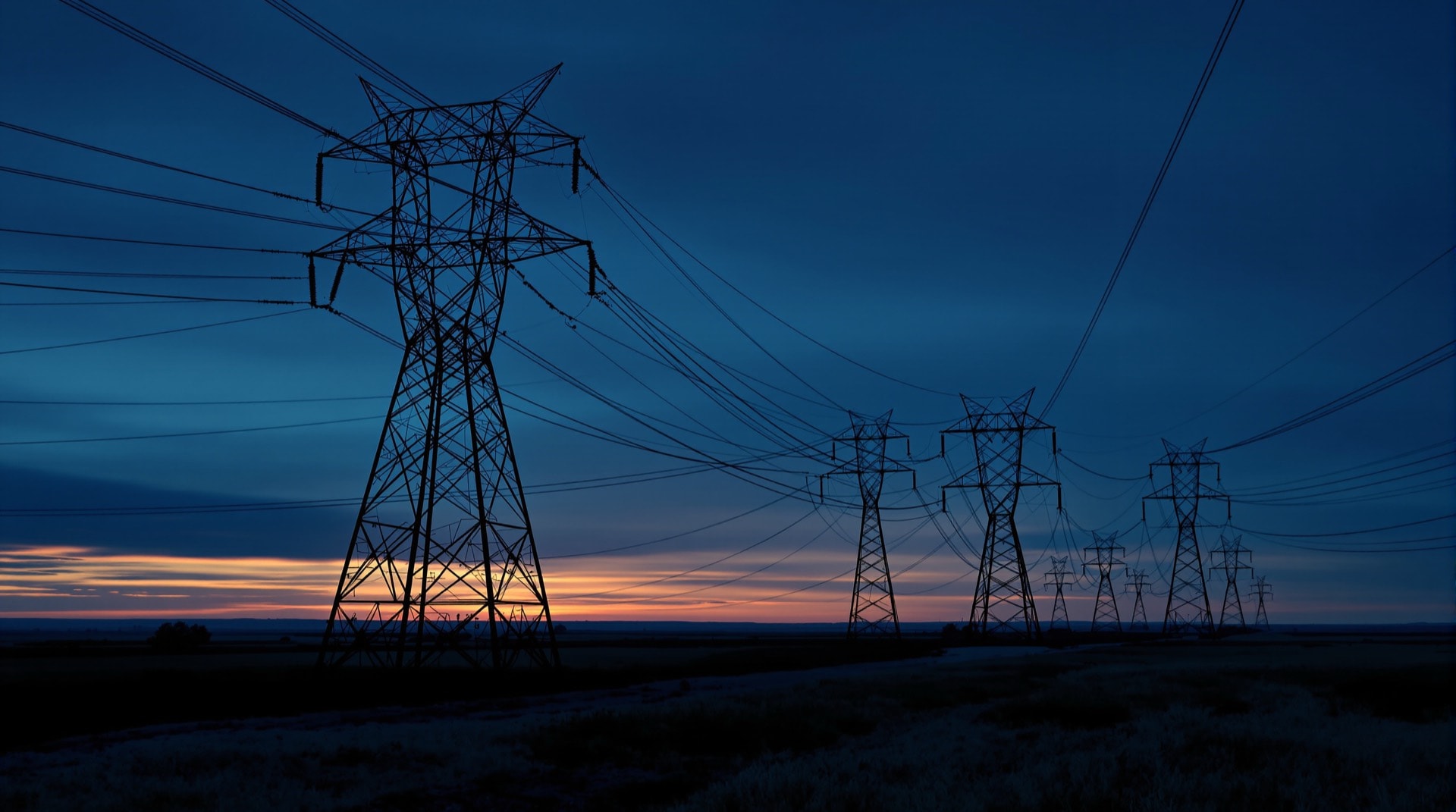
A power system is the machinery that takes energy from wherever it is produced and delivers it, as usable electricity, to wherever it is consumed. Described that way it sounds like plumbing. The reason it is a deep engineering discipline instead is a single awkward property: electricity is generated and consumed at the same instant. There is no meaningful buffer in the system as a whole. Whatever is being drawn right now must be produced right now, and the machinery that reconciles those two numbers has to do so continuously, automatically, and without ever falling far behind.
The Three Stages
Generation converts some other form of energy into electrical energy — thermal, hydraulic, wind, or photovoltaic. Historically this meant large synchronous machines: heavy rotating generators, physically spinning in step with the grid. That physical coupling matters more than it first appears, and we return to it below.
Transmission moves bulk power over long distances at high voltage. The reason for the high voltage is the most important single equation in the field: for a given amount of power, raising the voltage lowers the current, and the heat wasted in a conductor rises with the square of the current. Doubling the transmission voltage cuts the resistive losses to roughly a quarter. That is why the pylons carry hundreds of kilovolts and the socket in a wall does not, and why high voltage engineering exists as its own specialism.
Distribution steps the voltage back down in stages and fans it out to end users. The delivery to consumers overview from the US Energy Information Administration is a good, unhurried description of this hand-off from bulk transport to local supply.
Frequency Is the Balance Signal
The most elegant idea in power systems is that the grid tells you its own supply-and-demand balance, continuously, in a single number: its frequency.
Large synchronous generators are physically spinning masses locked to the grid's alternating current. If demand suddenly exceeds generation, that extra energy has to come from somewhere, and it comes out of the rotational kinetic energy of every spinning machine on the system — so they all slow down slightly, together, and the frequency falls. If generation exceeds demand, the surplus goes into speeding them up, and the frequency rises.
Frequency is therefore not merely a specification to be maintained; it is a real-time, system-wide readout of energy balance, available anywhere on the network with a cheap measurement. Control systems exploit this directly. Governor response adjusts turbine input within seconds of a frequency deviation. Slower automatic generation control then restores the frequency to its nominal value and returns exchanges between neighbouring regions to their scheduled levels.
The stored rotational energy that buys time for all this is called inertia, and it is the quiet reason grids have historically been forgiving. Inertia does not decide anything — it simply slows the rate at which frequency changes, giving controls a few seconds to act. A system with less inertia is not automatically unstable, but its frequency moves faster after a disturbance, so everything protecting it must be faster too.
Why the Inverter Transition Is a Genuine Engineering Problem
Wind and solar generation connect to the grid through power electronic converters rather than through a spinning mass locked to grid frequency. That brings real advantages — fast, precise, programmable control — but the physical inertia is not inherently there. It has to be deliberately emulated in software, through control strategies often described as grid-forming, as opposed to conventional grid-following inverters that assume a stable grid already exists and synchronise to it.
This is one of the most active areas in the field, and it is a good example of an engineering problem being misreported as a political one. The question is not whether inverter-based generation can support a stable grid; it is which control strategies, protection settings and interconnection requirements make it do so reliably at scale. Much of that work surfaces as interconnection and protection standards, which is why the IEEE Standards Association is a more informative place to watch this develop than any general news coverage.
Protection and Its Fundamental Trade-off
Faults are unavoidable: lightning strikes lines, trees fall on conductors, insulation eventually fails. Protection is the layer that detects a fault and disconnects the smallest section that clears it, in a fraction of a second.
The design tension is permanent and unresolvable. Protection that is too eager disconnects healthy equipment on transient disturbances, causing outages it was installed to prevent. Protection that is too relaxed allows fault currents to persist long enough to destroy equipment or endanger people. Every setting is a position on that spectrum, chosen deliberately. Selectivity — the principle that the device electrically closest to the fault should operate first, and its upstream neighbour only if that one fails — is what keeps a local fault from cascading into a regional outage.
Knowing the State of the System
Operators cannot measure everything. Real networks have far more nodes than instruments, and the measurements that do exist carry noise and occasional gross errors. State estimation is the technique that reconciles a redundant, imperfect set of measurements with the known physical model of the network to produce a single best estimate of the actual system state — and, valuably, to flag measurements that are inconsistent with everything else.
This makes power systems a signal processing and estimation discipline as much as an energy one, and it is entirely dependent on the quality of the underlying instrumentation. An estimator fed by badly calibrated transducers produces confident, precise, wrong answers.
Further Reading
For system-level context and consumption data, the EIA's Electricity explained series is accessible and regularly updated. For the engineering detail — interconnection requirements, protection coordination, power quality limits — the relevant IEEE standards are the documents practitioners actually work from.