Communication, Control and Robotics
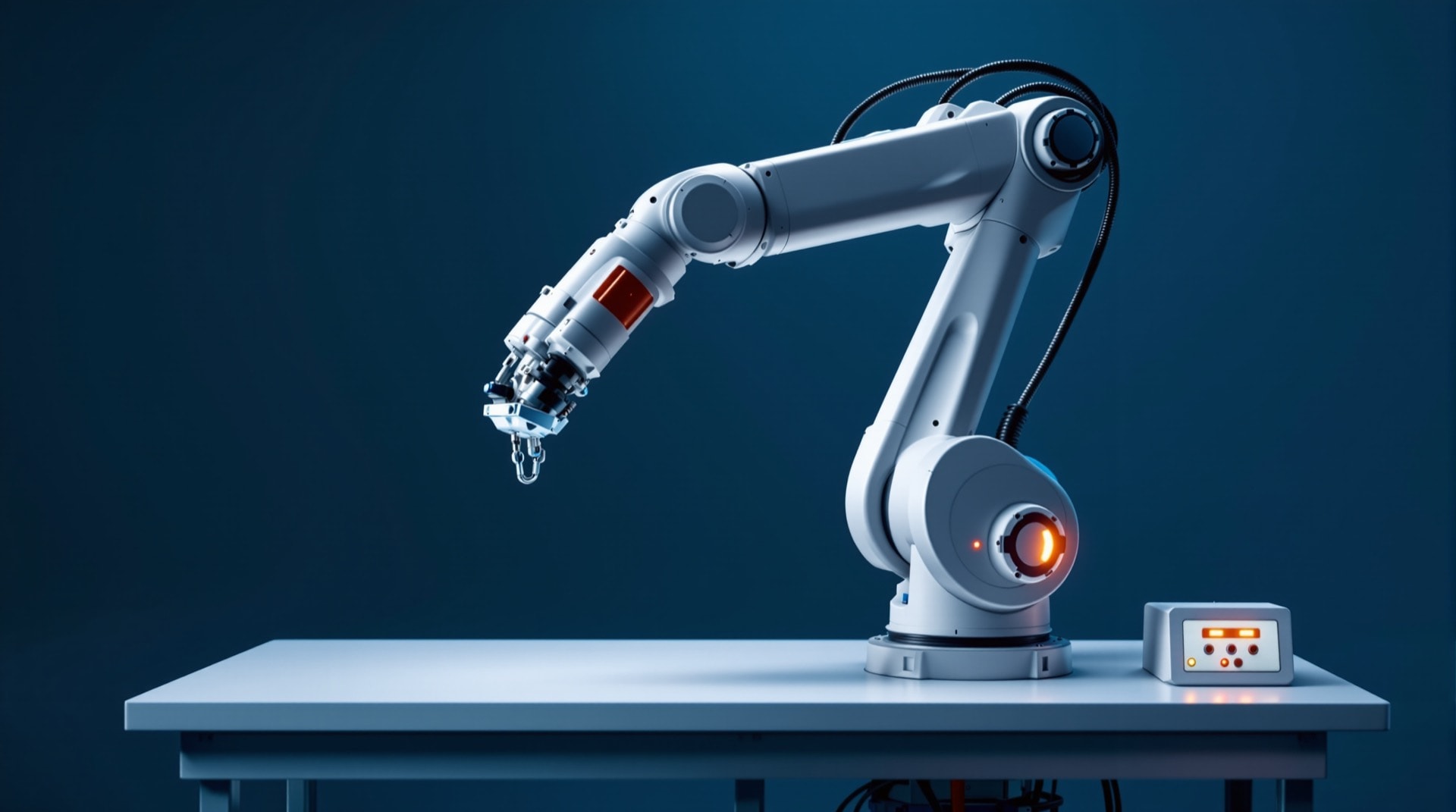
These three subjects are usually taught separately and are, in practice, inseparable. A robot is a control system with actuators attached. A control system depends on communication between where a quantity is measured and where a decision is acted upon. And the properties of that communication link — how fast, how reliable, how consistently timed — determine what control strategies are possible at all.
Feedback: The Idea Underneath Everything
Feedback control is one of the genuinely great engineering ideas, and it is deceptively simple to state. Measure the thing you care about. Compare it to what you wanted. Act in proportion to the difference. Repeat, continuously.
Its power lies in what it does not require. A feedback controller does not need an accurate model of the system it controls, does not need to know the disturbances acting on it, and does not need its actuator to be precisely characterised. It observes the error and reduces it, whatever the cause. This is why the same structure regulates a room's temperature, a drone's attitude, a chemical reactor's pressure and a hard drive's head position.
The classical implementation is the PID controller, combining three terms:
- Proportional — respond in proportion to the current error. Larger error, stronger correction. Alone, it typically leaves a persistent small offset, because some error must remain to produce any output at all.
- Integral — accumulate the error over time. This drives even a small persistent offset to zero, since the accumulation keeps growing until it does. The cost is sluggishness and a tendency to overshoot.
- Derivative — respond to the rate at which error is changing. This anticipates, damping the response before overshoot occurs. The cost is sensitivity to measurement noise, since differentiating a noisy signal amplifies the noise.
The three terms pull against one another, and tuning is the practical art of balancing them.
Why Stability Is the Hard Part
The non-obvious difficulty is that a feedback loop can be made worse by a stronger controller. Turn the gain up far enough and almost any real system will oscillate.
The reason is delay. Every physical system takes time to respond, and the controller acts on information about the past. If the total phase lag around the loop reaches half a cycle at a frequency where the loop still has gain above unity, the correction arrives exactly out of step — actively reinforcing the error it was meant to cancel. The loop becomes an oscillator.
This is why control engineering is a frequency-domain discipline. Concepts like gain margin and phase margin quantify how much extra gain or extra delay a loop can absorb before instability, and they are the numbers a practitioner actually designs against. It is also why the anecdote about a system that worked in simulation and oscillated in hardware is so common: the simulation omitted a delay that the real system has.
Communication as a Control Constraint
Once a control loop is closed over a network, the network's characteristics become control parameters.
Latency adds directly to loop phase lag and therefore erodes stability margin. Jitter — variation in latency — is often worse than latency itself, because a controller can be designed around a known constant delay but cannot easily compensate for one that changes unpredictably. Packet loss means the controller must decide what to do with no fresh measurement: hold the last value, extrapolate, or fall back to a safe state.
This is why industrial control networks emphasise determinism over raw throughput. A link that delivers a small message within a guaranteed bound every time is far more useful for control than a faster link whose timing occasionally varies. Consistency beats speed. The allocation of spectrum and the standards that make such links interoperate internationally are coordinated through bodies including the International Telecommunication Union.
Robotics: Where the Difficulty Is Not Where You Expect
Robotics inherits all of the above and adds the problem of acting in a physical world that was not designed to be convenient.
Kinematics relates joint positions to end-effector position. The forward direction — given the joints, where is the hand? — is straightforward. The inverse direction — given a desired hand position, what should the joints be? — may have many valid answers, or none, and the transition between configurations can require passing through awkward regions where small hand movements demand enormous joint movements. These are singularities, and they are a geometric property of the mechanism rather than a flaw in the software.
Perception is consistently the harder half. Converting raw sensor data into a reliable model of the surroundings is an image processing and estimation problem, and it is where autonomy projects most often stall. The long-standing observation that tasks trivial for humans — recognising objects, moving through cluttered spaces — are extraordinarily hard for machines, while tasks humans find hard, such as precise repetitive motion, are easy for them, remains one of the field's most reliable generalisations.
Autonomy becomes essential when communication cannot be relied upon. A spacecraft too far away for real-time commanding must decide for itself; the round-trip delay makes remote control physically impossible. That constraint has driven much of the serious work on verifiable autonomous decision-making, visible across NASA technology programmes, and it is now shaping terrestrial systems that must keep operating when a network link drops.
The motion itself comes back to power electronics: a robot joint is a motor driven by a switching converter, and the precision of the drive sets the floor on the precision of the machine. Research across this whole area is supported in the United States through the NSF engineering directorate.