High Voltage Engineering
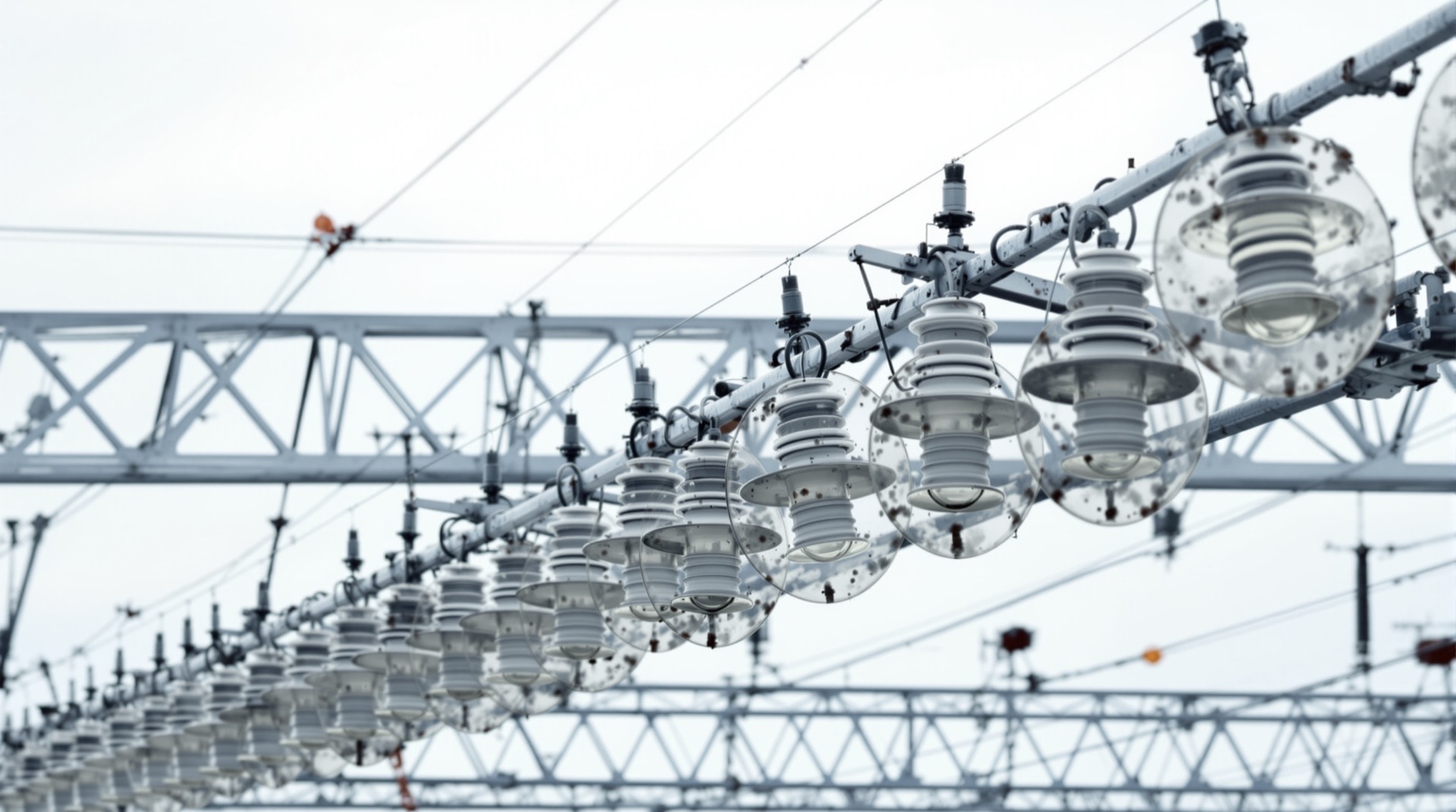
High voltage engineering is the study of what happens to materials, air and equipment when the electric field gets large enough that ordinary assumptions stop holding. Below a few kilovolts, an insulator is simply a thing that does not conduct. Above that, insulation becomes an active engineering material with its own physics, ageing behaviour and characteristic failure modes.
Why Bother With High Voltage at All
The motivation comes from a single relationship. Power is the product of voltage and current. Resistive loss in a conductor is proportional to the square of the current. So for a fixed amount of power delivered, raising voltage lowers current proportionally, and lowers loss quadratically.
Transmit a given power at ten times the voltage and you need one tenth the current, which produces one hundredth the resistive heating. That is the entire argument, and it is decisive — without it, long-distance electricity transmission would waste most of what it carried. Everything difficult about power systems at scale is the price paid for that efficiency.
How Insulation Actually Fails
Insulation does not degrade gracefully into partial conduction. It fails abruptly, and the mechanism is worth understanding because it explains nearly every design decision downstream.
In a gas such as air, a stray free electron — there are always a few, from background radiation — is accelerated by the electric field. If the field is strong enough, that electron gains sufficient energy before its next collision to knock a second electron free. Now there are two, both accelerating, both capable of doing the same. The population grows geometrically. This is an electron avalanche, and once it is established the gas transitions in microseconds from insulator to conducting plasma channel.
The abruptness is the point. There is no gentle warning region in which a designer can operate with reduced margin. Below the threshold the air insulates essentially perfectly; above it, an arc forms. Design therefore concerns itself with keeping the field everywhere below threshold — and the word everywhere is the difficult part.
Geometry Concentrates Fields
Electric field strength is not uniform. It concentrates sharply at points, edges and small-radius curves. A sharp corner on an otherwise generously proportioned conductor can produce a local field many times the average, and breakdown starts at the worst point, not the average one.
This is why high voltage hardware looks the way it does — the smooth toroids, the rounded fittings, the corona rings encircling insulator strings. They are not decorative or structural. They exist to eliminate small radii and spread the field out. Once you know to look for it, the aesthetic of high voltage equipment reads as a direct expression of field theory.
The partial version of this failure is corona discharge: the field near a conductor exceeds the threshold locally and ionises a thin surrounding layer, but the field further out is too weak to sustain a full channel. Corona wastes energy, produces audible hiss and radio-frequency noise, and generates ozone and nitric acid that slowly attack nearby materials.
Partial Discharge and Slow Death
Solid insulation fails by a slower and more insidious route. Manufacturing leaves microscopic voids — tiny gas-filled cavities inside cast resin, or between the layers of an oil-impregnated paper winding. The gas inside a void has a lower breakdown strength than the solid around it, so under normal operating voltage the void alone breaks down, repeatedly, thousands of times a second, while the bulk insulation remains sound.
Each of these partial discharges erodes a little of the void's wall. The void grows. Eventually it becomes a branching, tree-like channel — the phenomenon is literally called electrical treeing — and when a tree bridges the insulation, the equipment fails completely, often catastrophically and usually without any warning visible from outside.
Because the process runs over years, partial discharge measurement is one of the most valuable diagnostics in the field. Each discharge produces a fast current pulse detectable at the terminals, so measuring the rate and magnitude of those pulses gives a genuine indication of internal insulation health long before failure. Distinguishing real discharge activity from ambient electrical noise is where the difficulty lies, and it is a demanding signal processing problem.
Insulation Coordination
Equipment is not only exposed to normal operating voltage. Lightning strikes inject steep impulses of enormous magnitude but very short duration. Switching operations produce slower surges. Faults create sustained overvoltages on healthy phases.
Insulation coordination is the systematic practice of ensuring these stresses are handled deliberately: surge arresters clamp overvoltages to a known level, and every item of equipment is specified to withstand comfortably more than that. The goal is that if something must fail, it is the cheap, replaceable, deliberately chosen component — not a transformer.
Verification uses standardised impulse waveforms, so that equipment from different manufacturers is tested against the same stress. Those test procedures, waveform definitions and withstand levels are defined in the relevant standards published by bodies including the IEEE Standards Association.
Measuring What You Cannot Touch
Measuring hundreds of kilovolts accurately is its own problem: no instrument is connected directly. Voltage dividers, capacitive and inductive transformers, and optical sensors all reduce the quantity to something an instrument can accept, and each introduces its own error and frequency response.
For measurements with legal or safety consequences, the chain of calibration back to national standards is what makes a number defensible — the traceability infrastructure maintained by institutions such as the NIST Physical Measurement Laboratory. The measurements and instrumentation page treats this in general terms.